Home · Lessons · Nature & Landscapes
How to Draw a City Skyline at Dusk
A free step-by-step lesson in 10 steps — about 25 minutes with just a pencil, an eraser and paper. Draw the light shapes first; they get erased at the end.

The 10 steps

Lightly rule the waterline, and mark the sun's circle in a gap between the towers-to-be, with the heights of the two tallest towers.

Draw the back row first: four plain towers in lighter line, their tops at different heights like a distant neighbourhood.

Build the front-left towers bolder, including the tall stepped skyscraper — a narrower cap stacked on its roof.
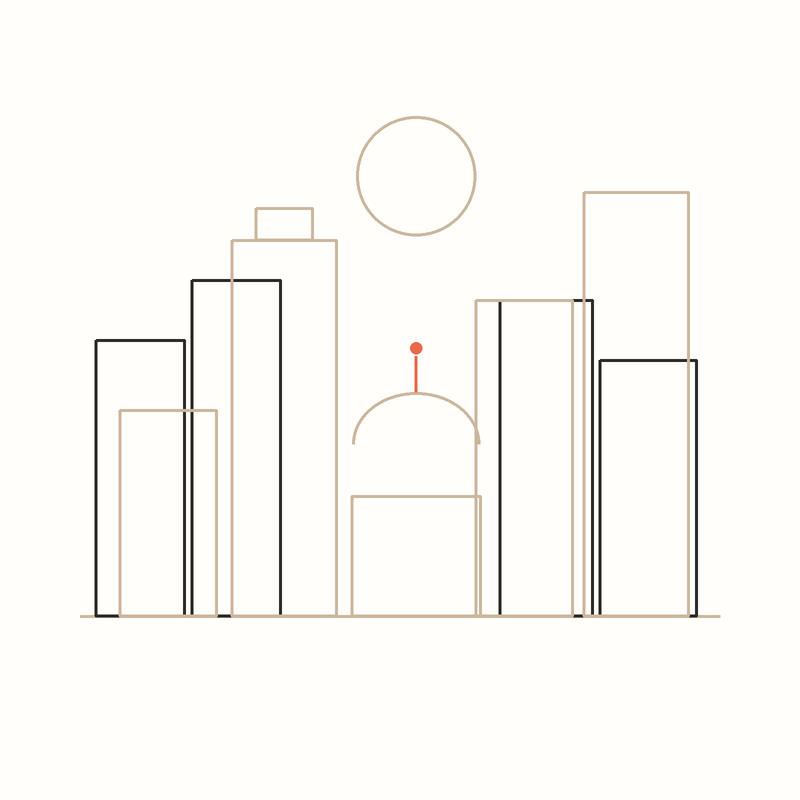
Build the front-right towers, then fit the domed hall into the centre gap: straight walls, a half-circle dome, a spire and a finial dot.

Set the low sun in its gap with an inner ring, add two flat cloud arcs and a pair of birds crossing the sky.

Grid the back row's windows: small dots in even columns and rows. Regular spacing is what makes them read as offices.

Grid the front towers' windows a little bigger and bolder — nearer buildings get nearer detail.

Top the towers off: an antenna with a beacon dot, a little water tower, a rooftop setback box, and the dome's arched door and windows.

Switch the city on: a scatter of warm gold windows, lit at random — never in a pattern, never all of them.
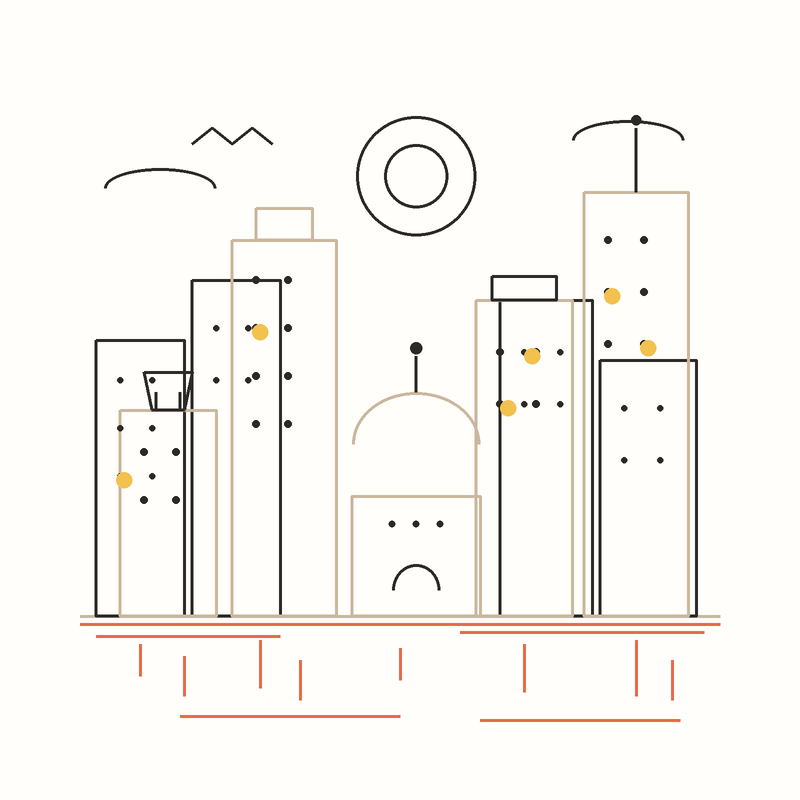
Finish with the waterline and broken vertical reflections under each tower, longer under the tallest. Master tier!
Coach tips for this lesson
Before you call it done, run these three checks — they're the same ones the app asks in its Coach Check:
- Do the towers overlap in two clear layers, with the back row simpler than the front?
- Are the windows in true grids — columns and rows aligned within each building?
- Are the lit windows scattered randomly, like real offices at dusk?
Depth in a skyline comes from layering: the back row should be plain rectangles with small windows, the front row bolder with rooftop detail. If every building has the same detail, the city flattens into a barcode. Push the detail forward and simplify everything behind.
Windows read as architecture only when they align: pick a column spacing per building and keep every dot on it, row after row. Wandering dots read as noise or stars. If a grid has drifted, redraw that building's windows on two faint vertical guides.
At dusk, lit windows are random — a few here, a small cluster there, most still dark. Lighting every window, or lighting them in a neat pattern, looks like a advent calendar. Light roughly one window in six, let two or three sit together by chance, and leave whole floors dark.
Finish this lesson in the app
In the free Draw.guru app you can trace this lesson on screen for an instant score, or photograph your paper drawing and overlay it on the reference with Smart Compare. Join the waitlist for launch.
One launch email, that's it. No spam, unsubscribe any time.